Short Sales Archives | Buy and Sell Properties Online New York Short Sales Archives | Buy and Sell Properties Online New York

Short Sales Hub

Do Cash for Home Buyers Charge Hidden Fees What NYC Sellers Should Ask

Do “Cash for Home” Buyers Charge Hidden Fees? What NYC Sellers Should Ask

What a cash for home offer can include, and what sellers should check before saying yes

When a New York homeowner starts looking at a direct sale, one question comes up quickly: “What will this actually cost me?”

Selling a property already brings enough pressure. A seller may be looking at repairs, a vacant home, unclear costs, or a buyer who changes details late in the process. Some are holding a vacant home. Others are trying to avoid a long listing process and want a simpler way to move forward.

A cash offer can be helpful in the right situation, but the seller should still understand the terms. “Cash” does not automatically mean every cost disappears. It usually means the buyer is not relying on a mortgage to purchase the property.

What sellers should watch for in the offer

A fee is not always written as a fee. It may be folded into a repair note, cleanup line, inspection change, service charge, or closing cost the seller did not expect.

A seller may hear one number at the start and assume that is the amount coming at closing. Then later, they may see adjustments for repairs, cleanup, title items, or other contract terms. The written offer is where the seller can see what is actually being offered.

A buyer should be willing to explain the price, timing, costs, and any part of the deal that might shift before closing.

Why cash buyers may structure offers differently

A traditional buyer may want the house as their next place to live. A cash buyer may be looking at repair work, rental use, resale plans, or holding the property for investment. That changes how the offer is built.

Many companies that buy houses for cash look at the home as it sits. The number can come down to the condition of the house, the repairs needed, cleanup, updates, and what the buyer thinks will happen after closing.

That does not automatically make the offer unfair. It simply means the seller should compare the cash number against the full cost of the regular home selling process, including repairs, showings, commissions, holding costs, credits, and time.

What questions should NYC sellers ask?

Before accepting any direct offer, the seller should ask direct questions.

  • Ask if there are service fees.
  • Ask who pays closing costs.
  • Ask which title costs stay on the seller’s side.
  • Ask if the offer stays the same after the buyer sees the house.
  • Ask when they would need to come by and look it over.
  • Ask how a new closing date would be handled.

The seller should also know who is behind the purchase. Is the buyer closing on it, or could the contract be passed to another buyer? Some sellers may be fine with that, but they should know it before they sign.

If a house buying company answers these questions clearly, the seller has more to work with.

Do cash buyers pay closing costs?

Sometimes they do. In other cases, the seller may still be responsible for certain items. The contract should say how the costs are handled.

Some buyers may say they pay typical closing costs, but “typical” is not always the same from one offer to another. Taxes, water bills, liens, attorney fees, transfer-related costs, and title problems should be checked in the actual agreement.

In New York, disclosure is also part of the conversation for sellers. In most covered residential sales, the seller must deliver a Property Condition Disclosure Statement before the buyer signs a binding contract. Some transfers are exempt, so sellers should confirm what applies with their attorney.

An as-is sale does not mean known problems can be ignored. It usually means the seller is not agreeing to make repairs before closing.

Why some sellers choose a cash buyer anyway

Some sellers search we buy houses for cash or we buy houses as is because they do not want to repair the home, host showings, or wait for a buyer’s mortgage approval.

The trade-off is usually price. A cash offer may be lower than what a seller might try to get on the open market. But the seller may also avoid repair costs, months of holding expenses, repeated showings, and uncertainty.

For a seller with a clean, updated home and enough time, a traditional listing may bring a stronger number. For a seller dealing with repairs, vacancy, inherited property, fire damage, or timing pressure, a cash sale may be worth comparing.

Elite Properties NY can help sellers review a direct sale option and understand what is included before moving forward.

Conclusion

So, do cash home buyers charge hidden fees? The answer is usually found in the written offer, not only in the first phone call.

Some direct buyers explain costs early. Others may keep a few parts unclear until the contract is in front of the seller. A phone quote gives the seller a place to start. The contract should lay out the price, costs, inspection terms, closing date, and any chance for the number to move.

A cash offer can still help in the right situation. Before moving ahead, the seller should know the payout, the likely closing date, and any costs or duties that still sit on their side.

For NYC sellers who want to compare a direct cash sale with a traditional listing, Elite Properties NY can help explain what is included in the offer before any decision is made.

Seller Questions

  1. Do cash buyers always charge fees?
    No. Some buyers do not charge a service fee. Others may write certain costs or deductions into the offer, so the seller should ask before signing.
  2. Can a cash offer change later?
    It can. The seller should ask early if inspection notes, title items, repair findings, or other issues could affect the final number.
  3. Is a cash sale always better than listing?
    No. A clean, updated house with a flexible timeline may still do better through a regular listing. A cash sale can fit when the seller wants less back and forth or does not want to deal with repairs first.
  4. Should a seller say yes to the first offer?
    No. Read the paper offer first. Look for the price, closing date, seller costs, and any conditions.
  5. Should a lawyer look it over?
    Yes. In New York, sellers should have real estate paperwork reviewed before they sign.
Leave a comment
Cash for Homes in NYC: How Long Does It Really Take?

Cash for Homes in NYC: How Long Does It Really Take?

What cash for homes timing can look like when selling directly in New York

When a homeowner starts thinking, “I need to sell my house,” timing usually becomes one of the first questions. A move date may already be on the calendar. The owner may also be tired of showings, calls, cleaning up before every visit, and waiting to see who follows through.

That is where a cash sale can feel worth looking at. For a simple NYC cash deal, 30 to 45 days is a common reference point. Title work, attorney calendars, property access, seller timing, or a co-op board can stretch that out.

Elite Properties NY can discuss a direct sale with sellers who do not want to prepare the home for a full market listing.

Why cash sales can feel faster

On a regular listing, the buyer may still be working through a mortgage. That brings in the bank, the appraisal, underwriting, and a few more people who have to sign off before closing.

With a cash buyer, that mortgage layer is usually removed. The buyer is not waiting for a bank to approve the loan. When the seller has the basics ready and title is clean, there may be fewer things holding up the file.

Even then, a cash deal still has steps. The buyer will want to look at the property, the terms have to be agreed on, and closing has to be handled the right way.

Before the buyer gives a number

Most buyers first want the simple facts: the address, the condition, who is living there, the seller’s preferred timing, and any repairs the owner already knows about.

That is why phrases such as we buy home, we buy homes, and we buy houses as is show up in searches. Usually, the seller wants someone to see the home without making repairs the starting point.

Photos, notes about the home, nearby sales, repair needs, and the buyer’s resale plan can all play into the offer.

What affects the timeline

Several things can make a cash sale move faster or slower.

The property’s title matters. Old liens, unpaid taxes, estate questions, open permits, or ownership issues may need attention before closing.

The seller’s paperwork matters too. In most covered New York residential sales, the seller must complete and deliver a Property Condition Disclosure Statement before the buyer signs a binding contract. Some transfers are exempt, so sellers should confirm the details with their attorney.

The property condition can also affect timing. A clean, vacant home may be easier to review than a property with major repairs, missing access, water damage, or unclear records.

Why some sellers choose this route

A cash sale can help when the seller wants a simpler path. Some owners do not want to repair the home, stage it, host showings, or wait for a buyer’s mortgage approval.

Others search for cash for home, cash for homes, or cash for houses because they want to compare a direct offer with the cost of listing. That comparison should include repairs, commissions, holding costs, credits, and waiting time.

The tradeoff is price. A direct cash offer can come in below what a patient seller might try for on the open market, because the buyer is also looking at repairs, resale time, and risk.

There is also the as-is side. Some companies that buy houses for cash review homes with old interiors, damage, cleanup needs, or delayed maintenance.

What to ask before accepting

A seller should not focus only on speed. The offer terms matter just as much.

Ask whether there are any fees. Ask who pays closing costs. Ask whether the buyer needs another inspection. Ask if the offer can change after review. Ask what closing date the buyer wants.

Some sellers see phrases like we buy houses cash or we buy houses in any condition and assume every buyer works the same way. Not every buyer handles deals the same way. The seller should be able to ask direct questions and get direct answers about price, timing, and the next step.

Elite Properties NY can walk sellers through a direct sale conversation, without making them prepare for a full market listing first.

Conclusion

In NYC, a cash sale timeline is not the same for every home. Each file depends on title work, paperwork, property condition, attorney coordination, and the seller’s schedule.

A cash sale may remove the mortgage approval step and reduce some usual listing delays. Before closing, the seller still has to slow down enough to check the numbers, dates, and contract language.

For many owners, the value is not only speed. It is having a route that feels less drawn out when repairs, showings, delays, or timing pressure are already becoming a problem.

FAQs

  1. Is a cash sale usually quicker than listing?
    It can be. Removing the buyer’s loan step may help, but title, paperwork, and contract terms still have to be handled.
  2. Can I sell before fixing the place?
    Yes. In many as-is conversations, the buyer looks first and lets the repair work show up in the offer.
  3. Will the cash number be the best number?
    Not always. The seller has to compare that number with the cost of repairs, the time involved, fees, and the certainty of closing.
  4. Could there be fees in a cash sale?
    Every buyer writes the offer differently. Look for any fees, closing costs, credits, or deductions in the actual terms.
  5. Should a seller have the paperwork reviewed?
    Yes. New York real estate contracts are not casual paperwork. A seller should have the right professional review the details before signing.
Leave a comment
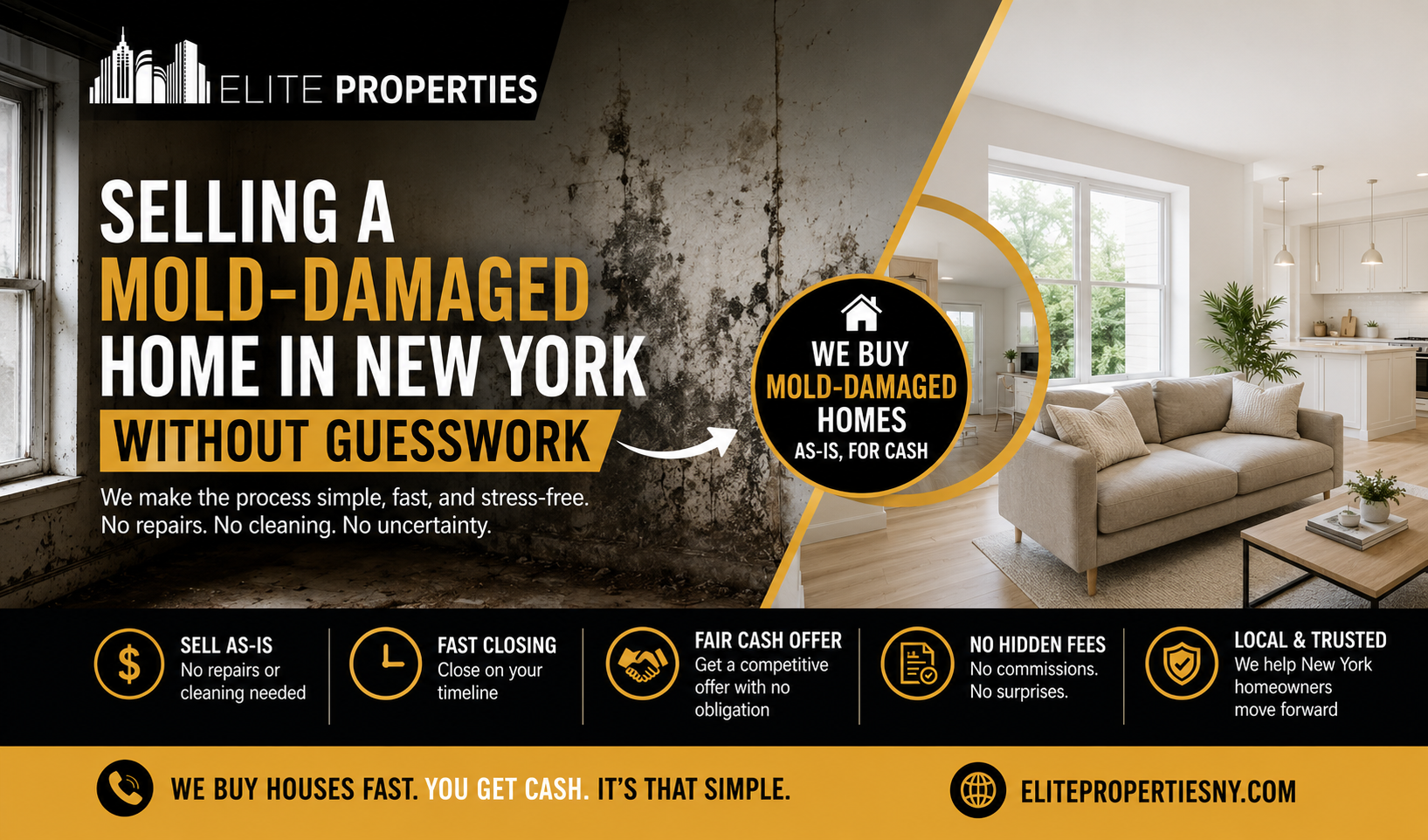
selling a mold damaged home in new york without guesswork with elite properties ny

Selling a Mold-Damaged Home in New York Without Guesswork

What selling a mold-damaged home in New York can look like for sellers?

Mold can change the tone of a sale fast. A buyer may see a stain near a window and start thinking about leaks. A basement smell can raise questions before anyone even talks about price. Once that concern is on the table, the seller has to be more prepared.

Homes with older leaks, basement dampness, staining, or a past mold issue do still sell in New York.

Elite Properties NY can help sellers look at an as-is option when mold repairs feel like too much to handle before selling.

Why buyers worry about mold?

Once buyers notice mold, the next question is usually about the source. Maybe it started with a roof leak, an old pipe, a damp wall, weak bathroom airflow, or water collecting near the foundation.

A small mark on drywall or a musty room can lead to testing, a contractor’s opinion, or another look behind the surface.

Repair invoices, old photos, test results, insurance notes, and remediation paperwork can help explain what happened. Records will not make every buyer comfortable, but they are better than trying to answer from memory.

Disclosure and as-is sales

New York sellers should take disclosure seriously. In most covered residential sales, the seller must complete and deliver a Property Condition Disclosure Statement before the buyer signs a binding contract. Some transfers are exempt, so the seller’s attorney should confirm what applies.

The old $500 credit workaround is no longer something sellers should rely on. The current form also asks about indoor mold testing, rot, water damage, and other known property conditions.

An as-is sale does not erase disclosure concerns. In most cases, it only means the seller is not agreeing to repair the property before closing. A seller should not use “as-is” as a way to ignore something they already know.

If the history is messy, or if there were serious leaks, insurance claims, or prior cleanup work, the safer move is to ask a New York real estate attorney before signing.

Should you repair the mold first?

The decision comes down to the house itself. If it is only one limited area and the source has already been fixed, a seller might clean it up before going live, especially if there is a receipt or report to show the work.

That kind of paper trail can make a regular buyer less nervous.

Bigger mold issues can take longer than expected. If the trouble is behind walls or connected to roofing, seepage, plumbing, or flooring, the repair plan can keep growing.

That is when a seller may start searching sell mold damaged house and looking at as-is options instead of managing the cleanup first. The price will usually reflect the condition, but the seller may avoid months of repair work and delays.

How mold can affect the price?

A mold issue usually makes buyers more cautious. They may bring in inspectors, ask for testing, request a credit, or lower their offer. When a mortgage is involved, the lender may also pay attention to the property’s condition before the deal moves ahead.

For anyone trying to sell house with mold damage, the repair estimate and the buyer’s offer need to be looked at side by side.

A traditional listing may still work if the home is otherwise strong, but broader repairs can bring more questions than offers.

Selling to a cash or as-is buyer

Some sellers search for we buy houses as is or companies that buy houses for cash because they are tired of repairs, cleanout work, and keeping the home ready for showings.

Many companies that buy houses for cash see homes with water damage, older interiors, tenant problems, mold concerns, and delayed maintenance. A cash for homes buyer may look at the house as it stands and build the needed work into the offer.

Elite Properties NY is a house buying company that may be a practical fit for sellers who want to discuss a direct sale instead of handling repairs first.

Cash terms should still be read line by line. Price is only one part; costs, inspection rights, closing date, and any re-trade language matter too.

What to review before choosing a path?

Before selling, the owner should get a practical picture of the home. Where is the mold? What caused it? Has the leak, dampness, or airflow issue actually been handled?

Keep estimates, mold reports, or contractor notes close by. If nobody has inspected the issue yet, photos alone can leave too much unanswered.

Mold work in New York is not something to hand to just anyone. For paid mold assessment or remediation work, the person or company generally needs the proper New York mold license. The same individual cannot handle both the assessment and the remediation on the same property.

Put both options side by side with the real costs. Listing may involve repairs, waiting time, buyer credits, and holding costs. An as-is offer may be lower, but the process may be more direct.

For anyone trying to sell a damaged house in New York, the main thing is what the seller keeps after repairs, credits, delays, and closing costs are taken out.

Conclusion

A mold issue does not have to keep a New York home from selling. It just changes the questions around moisture, buyer comfort, lender review, price, and what the seller already knows.

One seller may repair first and list afterward. Another may prefer an as-is sale because the cleanup is too much to take on before moving forward.

The seller should know the history, keep the records that matter, bring in licensed help when needed, and compare both selling routes in real numbers.

FAQs

  1. Can a New York home with mold still be sold?
    Yes. Mold does not automatically stop a sale. Known mold or water trouble should not be brushed aside when disclosure applies.
  2. Do sellers need to remove mold first?
    Not every time. Some fix the problem before listing. Some sell as-is and let the buyer handle the work after closing.
  3. Could mold affect the offer?
    It can. Once mold is part of the conversation, the buyer may look at the home with more caution and offer less.
  4. Can cash buyers still be interested?
    Yes. Mold and water problems are common in properties sold to cash buyers.
  5. Before saying yes, what should sellers check?
    The price is only part of it. The seller should also read the inspection language, closing date, costs, repair notes, mold history, and anything tied to disclosure.
Leave a comment
Cash for houses

Cash for house Sale vs. Short Sale: What’s the Difference and Which Is Better for You?

Where a cash for houses offer fits when selling gets complicated

A New York home sale can change quickly when mortgage balance, missed payments, repairs, and liens come into play.

Many owners compare two routes: a straight cash sale or a short sale through the lender. A cash sale is about how the buyer pays. A short sale is about asking the lender to approve a sale for less than the mortgage payoff.

What is a cash sale?

In a cash sale, the buyer is not using a mortgage. The funds come to closing without waiting on buyer loan approval. Title work and attorney review still matter, but one financing layer is removed.

This route can appeal to sellers who want a cleaner process. Maybe the place needs work, came through an estate, has tenants, sits empty, or is not easy to keep showing. Many companies that buy houses for cash review properties as-is, though every offer should still be checked carefully.

The tradeoff is price. A cash buyer is pricing cleanout, repairs, resale time, and risk. That is why the offer can come in below a polished retail sale.

What is a short sale?

A short sale usually enters the picture when the numbers from the sale will not cover the loan payoff. The owner might already have a buyer, but the bank or servicer still has to agree to take less than the balance owed.

The lender will usually want to see why the payoff is short, what offer is on the table, how the closing costs break down, what the property may be worth, and whether any other liens exist. A second mortgage, HELOC, judgment, or similar claim can add another approval step.

The file can go back and forth, especially if the lender wants updated numbers or a different offer.

A short sale can be part of a foreclosure discussion, but it should not be treated like an easy escape. Credit reporting, tax treatment, and any unpaid balance need to be reviewed before the seller commits. If debt is forgiven, it may have tax consequences. The approval letter should say whether the lender is forgiving the shortage or reserving any right to collect later.

Cash sale vs. short sale

The biggest difference is control. In a cash sale, the seller and buyer control more of the timeline. If title is clear, the contract is accepted, and both sides are ready, the process can move without buyer mortgage delays.

In a short sale, the lender has a major vote. The seller can agree to a buyer’s offer, but the closing is still waiting on the lender. If another lienholder is involved, that can add more waiting and more uncertainty.

A house buying company may make a cash offer quickly. If the property is underwater, cash alone does not solve the issue. The lender must accept the short payoff.

How to decide which route fits

A cash sale may fit when there is enough equity to clear the loan and the seller wants a direct way out. It can also fit homes needing repairs, inherited properties, vacant homes, or sellers who want to avoid the usual home selling process.

Some owners search for we buy houses as is because they do not want to repair or clean out the home. That usually connects more naturally with cash for homes buyers, though the mortgage payoff and any liens need review first.

A short sale may be the better conversation when the mortgage balance is higher than the home’s value and the seller cannot bring money to closing. It may be an option to discuss with the lender if foreclosure is a concern. An as-is buyer can still be part of the answer, but the lender’s approval remains the key piece.

This is not the part to guess through. The seller should know the payoff number, have a realistic read on the home’s value, and check whether liens or repair issues could affect the deal. Closing costs and tax questions should be reviewed as well. If foreclosure is already on the table, a New York seller should get advice from an attorney, housing counselor, or tax professional before signing.

Conclusion

A cash sale and a short sale are not the same solution. A cash sale focuses on how the buyer pays. A short sale focuses on a mortgage problem where the lender may approve a sale for less than the full payoff.

When there is equity, a cash offer may be easier to compare. When the mortgage is above the home’s value, the lender cannot be skipped.

Sellers should understand who gets paid, what debt remains, what the approval letter says, and what costs may still follow after closing.

Need help reviewing your selling options in New York? Elite Properties NY can help you compare a cash sale, short sale, or traditional sale based on your property, timeline, and situation.

FAQ: Questions NY Sellers Ask

  1. Are cash sales and short sales the same?
    No. A cash sale means the buyer is not relying on a mortgage. A short sale means the lender is being asked to approve a payoff below the full balance.
  2. Does cash change a short sale?
    Cash can make the buyer side cleaner, but it does not remove lender approval.
  3. Is a cash sale faster?
    It can be, with no buyer loan approval. The file still has to clear title, attorney review, and the seller’s own documents.
  4. What if foreclosure has already started?
    A short sale can be raised with the lender, but approval, paperwork, lienholder responses, and timing all matter.
  5. Where should a seller begin?
    If there is equity, compare a cash offer. If the loan balance is higher than value, speak with the lender early.
Leave a comment
Elite Properties New York Foreclosure houses

Facing Foreclosure: How ‘We Buy Houses’ Companies Help Homeowners Start Over

The Foreclosure Situation in 2026

This year, more owners are getting squeezed by missed payments and shrinking room to wait things out. What homeowners face can look very different depending on the market.

Geographic Hotspots: Some states are seeing a sharper rise than others, and local conditions often play a big part in that. The ATTOM 2026 U.S. Foreclosure Market Report highlights that market activity is steadily moving back to its usual historical patterns. This rise in filings is appearing most clearly in localized areas across the Midwest and Southeast.

Equity Gaps: Many owners still have a healthy amount of value built up in their homes. Conversely, some find themselves with very little left over after they account for all the standard selling expenses. Data from the National Association of REALTORS® suggests that while national equity remains strong, localized price corrections are creating gaps for distressed sellers.

Systemic Challenges: Refinancing is not always within reach, which is why some homeowners start considering a direct sale sooner than they expected.

Why Homeowners Search “We Buy Houses for Cash” When Time Runs Short

When you are under foreclosure pressure, speed matters, but so does predictability. A homeowner in distress usually is not looking for the perfect market scenario. They are trying to stop a downward spiral. They want to know how fast they can act and what the home is worth in its current condition.

That is where the phrase we buy houses for cash becomes more than a search term. It reflects a mindset of problem-solving. People searching those words are usually trying to avoid more delays and more bank fees. What they want to know is simple: can someone buy the property as-is without dragging the process out?

That certainty is a major asset. A direct buyer can often move faster because the process is more straightforward. There is no dependence on staging, repeated showings, or bank appraisals. While a traditional mortgage-backed sale can take 30 to 60 days, a cash sale can often close in a fraction of that time.

How a Direct Sale Can Help You Start Fresh

The biggest benefit of working with a home buying company is not just speed; it is relief. When a homeowner says, “I need to sell my house before things get worse,” they are trying to protect their future. They want a path that doesn’t involve the public nature of a foreclosure auction.

A direct buyer looks at the home exactly as it stands. The seller is not pushed to spend money they do not have on repairs before the process even begins. This is vital for those already under financial strain. If you are behind on payments, you do not need the added pressure to repaint, repair, or declutter for strangers to walk through.

What an “As-Is” Sale Can Take Off Your Plate

Deferred Maintenance: Major repairs do not have to be tackled first just to begin the process.

Financial Leaks: The sooner the sale is wrapped up, the less time there is for extra costs to keep piling on.

Credit Preservation: Selling before the process reaches the final stage may reduce how much long-term damage is done. Organizations like the Consumer Financial Protection Bureau emphasize that avoiding a completed foreclosure judgment is key to making the financial recovery afterward a little easier.

Why Many Owners Turn to Companies That Buy Houses

Traditional sales work well when you have plenty of time, but foreclosure risk changes the rules. It turns a regular sale into a race against the clock. This is why companies that buy houses often become the primary option for distressed homeowners. The goal is rarely to get a “retail” price; it is to get a guaranteed exit.

Most direct buyers start with a clear assessment. They look at the condition, the cost of future repairs, and any title problems or liens. For many sellers, this clarity is a massive weight off their shoulders. There is no waiting around for a buyer’s mortgage approval to come through. You also avoid the risk of an appraisal coming in low and killing the deal at the last minute.

Navigating the Legal and Emotional Weight of Foreclosure

For many owners, a direct sale feels like getting a say again. Instead of waiting for the bank to set the pace, they have more room to plan their move on more workable terms.

That next step looks different for everyone. For some, it means downsizing. For others, it means moving closer to family or simply cutting monthly pressure. When a sale happens early enough, some sellers may still leave with funds that help cover the move ahead.

A Simpler Step Forward

Even under foreclosure pressure, some homeowners still have time to make a choice before the situation closes in further. A direct sale provides one clear, manageable step that allows you to settle debts and move on.

That fresh start looks different for everyone. For one seller, it may mean avoiding a total loss of their investment. For another, it may mean leaving a property that has become a burden. This is why cash for houses is a meaningful solution. It creates an exit strategy when life has become too difficult to manage in its current form.

FAQs

1) How can “we buy houses” companies help if foreclosure is looming?
They offer another path for owners who want to sell before the process moves any further.

2) Do I have to make repairs before selling?
You typically do not have to invest more of your own money into renovations, deep cleaning, or staging for the market. Most direct buyers purchase properties as-is.

3) Is cash for houses only for homes in bad shape?
Not always. Some people go this route with a well-kept house simply because they need to move fast.

4) Why contact these companies instead of a real estate agent?
Agents are excellent for getting the highest price over several months. Direct buyers are for homeowners who prioritize speed and a 100% certainty that the deal will close on time.

5) Does a direct sale take some pressure off?
For most, yes. It simplifies the process to a single offer and a fast closing. This eliminates the hassle of hosting open houses. It also removes the frequent risk of a deal falling through because a buyer’s bank refused to fund the loan.

Leave a comment
We Buy Homes for Cash in New York

We Buy Homes for Cash in New York: How Elite Properties NY Makes Direct Offers

We Buy Homes for Cash: A Straightforward Path When You Need Certainty

New York real estate is famous for moving fast until it doesn’t. A listing can sit. A buyer can disappear. A “great offer” can turn into weeks of inspections, renegotiations, and lender delays.

That’s why more owners look for a direct buyer when life gets complicated. For owners who want a direct sale, Elite Properties NY can act as a direct buyer rather than taking the traditional listing route. We make offers, purchase properties directly, and close on timelines that make sense for real people.

If you are looking for companies that buy houses for cash, your search is about more than just finding a buyer. You are essentially trying to solve a puzzle. You need a straightforward decision and a concrete path forward. Most of all, you want an exit strategy that does not involve turning your daily life into a full-time real estate project.

From the seller’s side, the hardest part is usually the uncertainty. You can do everything “right” and still end up stuck: waiting on a lender, dealing with inspection demands, juggling showings, or losing time while someone decides if they “still love it.”

That uncertainty is expensive in New York. Mortgage payments, taxes, insurance, and utilities don’t pause just because the sale is taking longer than expected. According to recent market data and trends, extended holding periods and the risk of a deal falling through can significantly eat away at a seller’s final bottom line.

From the seller’s side, there’s also the reality that not every home fits the traditional retail lane. Some properties are dated. Some are inherited and still full of belongings. Some have tenants, violations, or deferred maintenance that makes a standard listing feel like a battle.

And in the toughest cases, owners need to sell fire damaged house properties where repairs, remediation, and insurance conversations stack up quickly. When that happens, many sellers aren’t looking for a “perfect strategy.” They want a practical exit and a timeline they can plan around.

Now here’s how we look at it. From Elite Properties NY’s side, our role is simple: assess the property as it sits today and decide what we can pay based on real-world cost and risk.

When we say we buy houses in any condition, we mean we don’t require you to repaint, renovate, stage, or “make it market ready” to start the conversation. Condition matters to price, but it doesn’t block the process. We evaluate:

  • Location and neighborhood trends.
  • Property type (Single family, multi-family, etc.).
  • Occupancy status and potential legal hurdles.
  • Repair scope required for the next chapter.

From Elite Properties NY’s side, the goal is clarity, not drama. A direct sale works best when the expectations are clean: we buy homes as-is, we’re taking on the post-closing work, and you’re getting a straightforward offer you can accept or decline without pressure. This is why people choose companies that buy houses for cash, not because they don’t care about value, but because they care about certainty.

What the process looks like (without the fluff)

When we buy homes for cash, we start by learning what you’re working with and what timing you need. Some owners send a few photos and notes; others prefer we take a quick look in person so we can be accurate.

Then we share a written offer that matches the home’s current state and the work we’re taking on. Take a look, and if it works for you, we proceed; if it doesn’t, you can simply decline.

If you accept, we move into title and closing coordination. In many cases, cash deals move faster simply because there is no lender underwriting, no lender-required appraisal, and no financing contingency to manage. That’s one of the biggest reasons sellers search cash for houses in the first place.

What can change the offer

Sellers often ask, “What do you look at?” The biggest factors are straightforward: location, overall condition, property type, occupancy, and title complexity.

  • If the home needs major work, the offer reflects that work.
  • If there are tenants, we factor in the added coordination.
  • If you’re trying to sell fire damaged house property, we look at the scope: smoke, structural impact, electrical, and water-related issues from firefighting.

Again: it’s not a judgment. It’s the math of what it takes to take responsibility for the property after closing.

Final Thoughts on Selling Your New York Home for Cash

A traditional sale can work well when a home is turnkey and time is on your side. But when you want speed, simplicity, and fewer moving parts, a direct buyer can be the better fit.

Elite Properties NY exists for that lane. We buy homes for cash, we evaluate properties honestly, and we keep the process clear so you can make a decision and move forward, especially when the usual listing route feels like too many unknowns.

FAQs

1) Are you one of the companies that buy houses for cash in New York?

A: Yes. Elite Properties NY buys properties directly, and we can close with cash, so the deal isn’t dependent on a buyer’s mortgage approval.


2) Do you really buy houses in any condition in New York?

A: Short answer: Yes. Long answer, we buy houses in any condition, from the ones that are move-in ready to those that need serious repair. The thing worth noting is that Condition affects price and not eligibility


3) Can you help if I need to sell fire damaged house property?

A: Often, yes. We review fire-related damage case by case and can make an as-is offer when it’s a fit.


4) Is cash for houses always “faster”?

A: It’s usually faster because there’s no bank underwriting or appraisal timeline, but closing speed still depends on title and paperwork.


5) Will I have to clean out the home first?

A: In many cases, sellers choose a direct sale specifically to avoid a long cleanup and prep cycle. Tell us what you’re dealing with and we’ll explain what is realistic for your situation.


Leave a comment
sell your house

Sell My House Quick: Overcoming Hoarder Home Hurdles in New York

How Can I Sell My House If It’s a Hoarder Property?

Tackling a hoarder home right here in New York often twists a simple transaction into something way more complicated. Maybe you’re looking at stacks of junk that’s piled up forever, scratching your head on where to start, you’re definitely not the only one. In 2026, with the city’s real estate market still buzzing but picky about condition, selling such a property brings unique hurdles, like safety concerns, legal snags, and the sheer effort of clearing out. On the bright side, though: there are ways to go about it, particularly with folks who do cash buys on “we buy houses as-is” terms. Over at Elite Properties, this is our wheelhouse, stepping in for owners to sell house in a flash minus the standard mess-clearing fuss. Doesn’t matter if it’s stuff from a passed-on relative or decades of buildup, we’ll dig into the tough bits and real steps ahead to offload your place how you want.

From the Seller’s Perspective: Navigating the Emotional and Practical Mess

Imagine: your spot’s turned into something like a warehouse, stuffed with bits from aged mags to lost gems, and suddenly you’ve gotta let it go. On the heart side, it’s rough, could be a kin’s pad full of old times, or lending a hand to someone close who’s dealt with collecting too much.

In New York, where space is gold, buyers expect turnkey spots, so listing traditionally means facing inspections that flag hazards like mold or fire risks from the buildup. You might spend weeks or months decluttering, hiring pros who charge a fortune, all while paying holding costs like taxes and utilities. Sellers I’ve chatted with often say, “How can I sell my house when it’s this overwhelming?” It’s not just the physical work; it’s the stigma too, scaring off regular buyers and dragging out the process in a market that’s already competitive.

From the Seller’s Perspective: Tackling Market Realities and Hidden Costs

On top of the personal side, the hard facts pack a punch. New York’s rules for deals in 2026 clamp down harder on whether a place is livable, meaning a packed-up spot might call for sign-offs or touch-ups to get the green light, piling on waits and expenses.

Think about staging, impossible without a massive clear-out, or open houses where potential buyers bolt at the door. Many folks end up with lowball offers from flippers who see the mess as leverage. If you’re asking, “Can I sell my house without touching a thing?” the answer’s tricky in the traditional scene, where agents push for renos that eat into profits.

Plenty of people we’ve come across drained their bank on hauling services, just to hit roadblocks like property claims or rule breaks showing up during the deal. Man, it wears you down, flipping a potential new beginning into a drawn-out mess.


From Elite Properties’ View: Streamlining the Process for Hoarder Homes

Here at Elite Properties, we totally understand these packed homes aren’t plain real estate, they come with layers that need a straightforward fix. Folks ring us up going, “Gotta move my place quick, but it’s jammed full,” and we dive right in with a plan that fits. We scoop up spots straight-up, no changes needed, so you don’t have to touch the sorting. Our group figures the worth from where it sits and what it could be, ignoring the chaos, and we tackle whatever tidying comes after we take over. With NYC’s scene zipping along in 2026, we’ve pulled lots of people out of jams, like those Brooklyn townhouses drowned in gear or Queens pads dealing with renter stockpiles. Pondering, “How can I sell my house minus the bother?” That’s where we shine, we foot the end fees, ditch the cuts, and wrap in a handful of days instead of dragging on.

From Elite Properties’ View: Offering Compassionate, Efficient Solutions

Our take on these deals comes with real understanding, since stacking stuff usually ties back to bigger tales. We kick off with a fast drop-by, zero side-eye, and a solid payout pulled from actual numbers. We’ve sorted all kinds: fine-tuning health rules, family wrap-ups, or lining up experts for careful emptying once it’s ours. Our strong suit? Being from around here and knowing the areas inside out, so we slide through district regs or building guidelines without a hitch. If you’re hunting “we buy homes” for sticky cases, we bring the calm, no loan snags, no folks bailing last second. Bottom line, it’s giving you the tools to step ahead, shifting a heavy load into fast funds without piling more on.

Conclusion

Moving a stuffed home in New York shouldn’t lock you into nonstop worry. As 2026 rolls in with tougher standards on how ready a spot needs to be, spotting the rough patches matters, but hey, so do the fixes like teaming with a direct payer. With us at Elite Properties, you can ditch your place exactly how it stands, jumping over the sorting and holdups for an easy road out. If that’s ringing bells for you, give a holler, how about we flip that chaotic area into a done deal and some new cash?

Frequently Asked Questions

Q: What makes selling a hoarder house harder in New York?

A: Local rules around staying safe and fit for living usually mean big sweep-outs, and the scene leans toward spotless spots, stretching out how long it takes to move.


Q: Do I have to clean out the house before selling to you?

A: Not at all, we grab spots just how they are, taking care of hauling stuff once it’s wrapped.


Q: How fast can the sale happen?

A: We’ll toss a proposal your way in a couple days and seal it in roughly seven, matching what works for you.


Q: Are there fees involved?

A: Zero commissions or hidden costs, we cover everything.


Q: What if there are legal issues like liens?

A: We sort ’em out, usually clearing tabs from the cash to make it smooth.


Q: How do you value a hoarder property?

A: Based on comps, location, and structure, not the clutter, for a fair price.

Leave a comment
House selling company

Selling a Fire-Damaged House in New York: Options, Timing, and Your Next Step

A house fire changes your day in seconds. After the trucks leave and the smoke clears, you’re often staring at the same questions most homeowners never plan for: Is the place safe? Can I even stay here? Do I repair it, or do I just sell and move on? 


If you’re reading this because you need to sell your house after a fire, take a breath. You do have options in New York. The best route depends on how serious the damage is, how quickly you need to act, and whether you want to repair the property or sell house as-is. 


Step 1: Understand What “Fire-Damaged” Means in Real Life

Fire damage isn’t one single category. Two homes can both be called “fire-damaged” and look completely different. After a fire, you can usually see the surface issues quickly, but the “real story” takes a closer look. It is what lies beneath that requires special attention, wiring, framing, or any damp areas that need time to dry, whereas smoke marks and residue are easier to spot.
 

To get moving without guessing, focus on two basics:
• A quick walk-through from a contractor to highlight the real problem areas
• Your insurance position, at least at a high level (what’s covered, what’s delayed, and what’s still being decided). You don’t need every answer on day one. But you do need enough facts to avoid spending money in panic or getting stuck in limbo.  


Your Options for Selling a Fire-Damaged House in New York 


Option 1: Repair, then list on the open market

This route is often best when the damage is limited, and you’re in a position to fund and manage the repairs. Once the home is restored, you may get a broader buyer pool and a stronger price. That being said, getting this done is a different beast altogether; there is a whole host of variables to be considered: NY permits, inspections, contractor availability, and the surprises that pop up once the work begins. Fire repairs may also require additional permits, documentation, especially when structural, electrical, or remediation work is involved.
  

If your goal is to sell quickly, this route can start to feel like progress comes in stops and starts. 


Option 2: Sell as-is to an investor or cash buyer

If your main goal is speed, simplicity, or avoiding a long rebuild, you can sell fire damaged house in its current condition. This is where companies that buy houses often come in, especially buyers offering cash for home who are prepared for rehab work. 


A direct as-is sale typically appeals to sellers who don’t want to manage cleanup, contractors, or weeks of back-and-forth. You’re basically trading “top market price after renovation” for a cleaner process and fewer delays. 


If you want to sell house as-is and avoid turning this into a months-long project, this is often the most straightforward path. 


Option 3: Do a small cleanup, then sell as-is

Some sellers take a middle route: clear debris, address basic safety, and make the home easy to access, then sell house as-is. This isn’t a renovation. It’s more like “making the property presentable enough for a serious evaluation.” 

This can help a buyer assess the home faster and sometimes reduce confusion around the scope of damage. 


Timing Overview: What to Expect

The Truth is: Timelines vary. In New York, timing usually breaks into a few common tracks:
• Repair and list: can stretch across months, influenced by permits, inspections, and contractor timing
• As-is sale to a cash buyer: can close sooner, since you’re not waiting on repairs or lender sign-off
• Light cleanup + as-is sale: depends on how quickly you can clear access and address the basics 


If you’re paying holding costs, mortgage, taxes, utilities, or the home is sitting empty, every extra week adds up. Setting a realistic timeline early helps you pick the option that matches your situation, not just the “ideal” plan. 


What Buyers Often Ask After a Fire 

Whether you list traditionally or go as-is, expect questions like:
• Is the cause of the fire known?
• What was affected, smoke, structure, electrical, or water-related damage?
• Are utilities on, or were they turned off afterward?
• Has any cleanup happened yet (soot, odor, drying, mold prevention)?
• Where does the insurance claim stand right now, open, pending, or closed? 


You don’t need a perfect folder of documents on day one. Just be consistent about what you know, and upfront about what you’re still confirming, it prevents confusion later. 


How Elite Properties NY Can Help
If you’re dealing with fire damage and want a simpler route, Elite Properties NY can review the property and explain what a direct sell house as-is option would look like. If it makes sense for the property, they can share a clear offer. This option is often chosen when the goal is fewer steps and a simpler closing. 


Conclusion:

After a fire, decisions tend to come quickly. Start with the facts, then choose the route that fits your timeline, repair and list, sell house as-is, or do a small cleanup and sell. 

If speed is the priority, working with companies that buy houses and offer cash for home can be a practical option, especially when you want to sell fire damaged house without taking on a long rebuild. 


FAQs:

  1. Can I sell a fire-damaged house in New York without repairing it?
    Yes. Plenty of owners sell house as-is, especially when repair costs are high or the rebuild timeline doesn’t fit their situation. 
  1. Does selling as-is usually affect the price?
    Usually, yes. The offer often reflects the repair cost and risk the buyer is taking on. 
  1. Do cash buyers really buy home as-is after a fire?
    In many cases, yes. The buyer will look at things like where the home is, how the damage affects the main systems, and whether the property can be evaluated safely. 


Leave a comment
House selling company

Foreclosure in New York: What It Means and How It Works

Foreclosure in New York

Foreclosure is a word most people only look up once it’s already on their mind. In New York, lenders usually kick it off by filing a foreclosure lawsuit after payments have been overdue for a while. It’s not one-and-done; once court mail and formal notices arrive, the window to act can feel smaller.

If you’re trying to Avoid foreclosure in New York, it helps to pin down your current stage, read what the latest notices are telling you, and decide what to do next while you still have options.

Foreclosure, Without the Legal Jargon

A mortgage is a loan tied to your home, and the home secures that loan. After a payment is missed, most lenders begin with late notices and follow-ups to collect. If the loan remains unpaid, they may move forward and ask the court to enforce the loan terms.

New York typically uses a court-based foreclosure process. You’ll likely get notices, mailings, and deadlines you can’t ignore. The fine details vary, but the order of events is often similar.


How the Foreclosure Process Commonly Unfolds

1) Missed payments and notices

It usually begins with a missed payment, then another, and the costs and notices start to build. Most people think they’ll fix it quickly, but the longer it drags on, the harder it can be to get back to “current” status.

2) The lender files a case

If the balance still isn’t brought current, the lender may file in court. That’s usually when it turns formal: legal papers arrive, response dates start counting, and the case moves forward on a court schedule.

3) Settlement talks or loss-mitigation options

In many situations, you can still look at alternatives, like a modification, a repayment plan, or other lender options intended to cure the default and keep the case from advancing.

4) Judgment and auction (or transfer)

If nothing is agreed to, the case may continue toward judgment and a foreclosure sale/auction. As that happens, timing becomes tighter and the number of workable options usually drops.


Options That May Help You Avoid Foreclosure

Every homeowner’s situation is different, but these are common paths people explore:

1) Bring the loan current

If you can catch up (sometimes with help from family, refinancing, or a structured plan), that can stop the process. The challenge is timing, many people try this after the numbers already feel unmanageable.

2) Loan modification or repayment plan

Some lenders will consider adjusting terms. It’s paperwork-heavy, and results vary, but it can be worth exploring early.

3) Short sale

A short sale means selling the home for less than what is owed, with the lender’s approval. This is not always simple, and many sellers prefer to work with Short sale specialists NY because the lender approval process and documentation can be intense.

4) Sell the home before foreclosure finishes

For many people, selling is the cleanest way out, especially when the monthly payment no longer fits the budget. If your priority is speed, you may be thinking: “How do I Sell my house fast without repairs, showings, and delays?”

That’s where companies that buy houses for cash can be an option. A direct cash sale won’t fix every situation, but it can help some homeowners avoid the uncertainty of waiting for an auction date.


Selling “As-Is” When the Home Isn’t Perfect

Foreclosure risk often shows up alongside home-condition problems, repairs you’ve postponed, tenant situations, or damage that makes listing harder. Traditional buyers may expect inspections, lender conditions, and repair negotiations that slow the timeline even more.

If you’re dealing with major damage, you might be looking for a way to sell fire damaged house without taking on a renovation project.

This is where sellers look for buyers who say things like we buy houses in any condition and we buy houses as is, because the home selling process is more direct, and you’re not expected to fix everything first.

At Elite Properties NY, we purchase homes in New York in a straightforward way, including properties that are outdated, distressed, or difficult to list. If you’re facing foreclosure timelines, a direct sale can be a practical alternative to dragging through months of uncertainty.


Conclusion

Foreclosure moves in stages, and each stage can narrow your choices. First, confirm your stage. From there, pick the option that matches your reality: catch up, negotiate with the lender, try a short sale, or sell before the case gets close to a sale date. If you’re short on time, an as-is buyer may help you move faster and reduce the pressure.


FAQs

1) How long does foreclosure take in New York?

There isn’t a single “normal” timeframe. How quickly it moves varies by lender and by county, plus how fast documents and replies are handled. If notices are showing up, don’t ignore them, consider speaking with a housing counselor or an attorney.

2) Can I sell my home if foreclosure has already started?

In many situations, yes, especially if you begin while there’s still time to close. Getting started sooner usually makes everything less rushed.

3) Short sale vs. foreclosure: what’s the difference?

In a short sale, the lender agrees to a sale price that won’t fully cover the remaining mortgage balance. Foreclosure is different: it’s the lender’s legal route to take the property back after a default.

4) Do cash buyers really purchase homes in poor condition?

Some do. Many sellers choose this route specifically because we buy houses in any condition and we buy houses as is options avoid the repair and listing cycle.

5) Will selling fast stop foreclosure automatically?

Not automatically. It depends on timing and closing. If you’re close to key deadlines, move quickly and get professional guidance to coordinate the sale.

Leave a comment
Style Selector
Select the layout
Choose the theme
Preset colors
No Preset
Select the pattern